
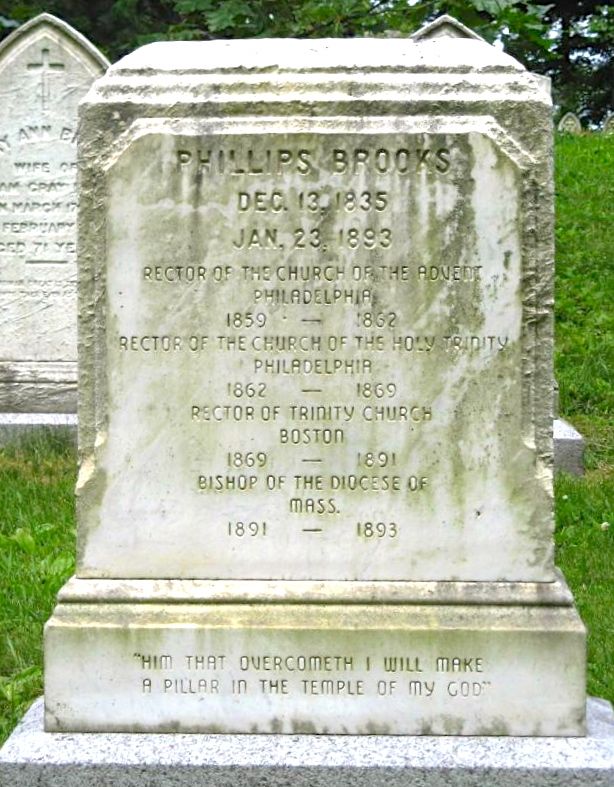
 Rev. Phillips Brooks (1835–1893) died in Boston 120 years ago today. It is said that Christians throughout the world mourned his death, and his funeral was “like that of a king.” Brooks has been called by some “the greatest American preacher of the 19th Century.”
Yet sorrow soon turned to songs of triumph and praise of God for Phillips Brooks’ life. Over his tomb they would erect these words: “A preacher of righteousness and hope, majestic in stature, impetuous in utterance, rejoicing in the truth, unhampered by the bonds of church or state, he brought by his life and doctrine fresh faith to a people, fresh meanings to ancient creeds.” [Dan Graves in Christianity Today online article, June, 2007]
Brooks was the Episcopal Bishop of Massachusetts when he died, having also served important churches in Boston and Philadelphia. Most Americans know him as the author of the popular Christmas carol, “O Little Town of Bethlehem” — which he wrote a couple years after visiting Palestine in 1865. While there, Brooks journeyed from Jerusalem to Bethlehem on horseback, and there assisted with a midnight service on Christmas Eve. He would later write, “I remember standing in the old church in Bethlehem, close to the spot where Jesus was born, when the whole church was ringing hour after hour with splendid hymns of praise to God, how again and again it seemed as if I could hear voices I knew well, telling each other of the Wonderful Night of the Savior’s birth.”
On his preaching, the Encyclopedia Britannica says
In Lectures on Preaching (delivered at Yale University in 1877), Brooks offered his most influential assay of his profession, defining preaching as “the bringing of truth through personality,” by which he meant a kind of radiant optimism. His own eloquence was matched by his commanding, handsome figure, standing six feet four inches tall and weighing (in his prime) 300 pounds. His charismatic preaching became so renowned that he was invited in 1880 to preach at Westminster Abbey in London and at the Royal Chapel at Windsor before Queen Victoria. In 1890 he conducted an acclaimed series of services at Trinity Church, New York City. Several volumes of his sermons were published during his lifetime and posthumously. [online EB article]
At the Trinity Church in Boston (which Brooks helped design) there was no pulpit until 1888, but Brooks preferred to preach from a modest lectern near the rector’s stall, typically only wearing his black academic gown. And later on, during communion, he would preach not from the pulpit but from the chancel steps.
It is said that he despaired of Anglo-Catholic ritualism, and championed more congregational singing. During his childhood, the Brooks family spent Sunday evenings singing hymns. He would grow-up to know over two hundred hymns by memory, and often quoted them in his sermons.
Brooks was also known for his vocal defense of the Trinity as Unitarianism was then on the rise throughout New England.
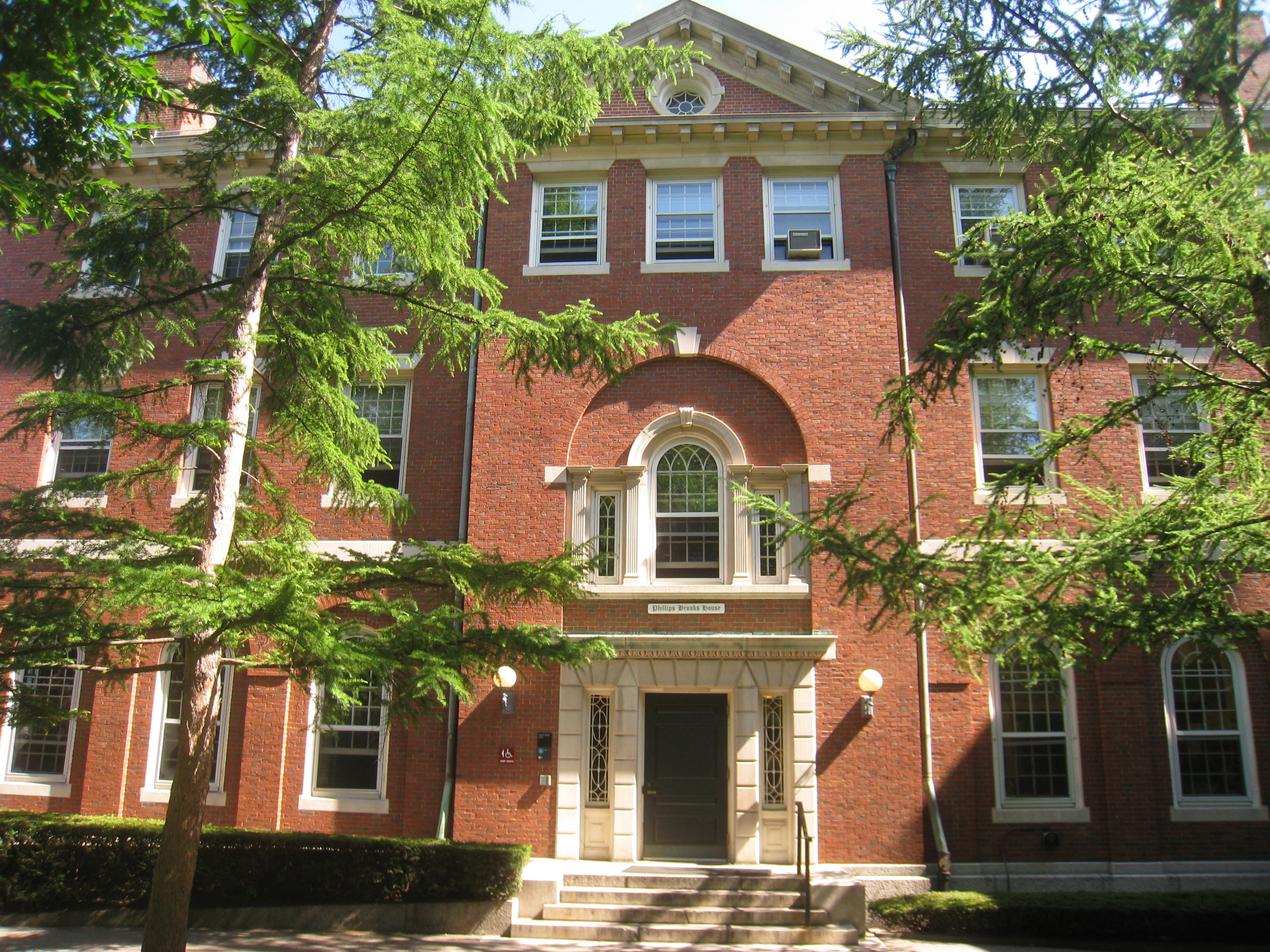
Phillips Brooks House at Harvard
Phillips Brooks never married, or had children of his own. Dan Graves, in closing his Christianity Today article, observed that this famous preacher
…loved children and liked to romp on the floor and play with them. He often wrote delightful letters to his young friends. That explains why, when Brooks died on January 23, 1893, a five year old was upset because she had not seen her preacher friend for several days. Her mother told her Bishop Brooks had gone to heaven, and the child exclaimed, “Oh, Mama, how happy the angels will be.”
Yes, but happier yet would the man be, for he would now see Christ. He had written that the Christian’s goal should be “To know in one’s whole nature what it is to live by Christ; to be His, not our own; to be so occupied with gratitude for what He did for us and for what He continually is to us that His will and His glory shall be the sole desires of our life.”
Amen.

 The Breadline