
Unknown's avatar

About Rev. Dr. David Bissett

I pastor a church in upstate NY. I'm happily married and the father of seven kids. It's fun, really! Leave me some feedback...

“Puritans Portraits” by J.I. Packer (a review)

9781845507008Puritans Portraits, J.I. Packer on Selected Classic Pastors and Pastoral Classics. Christian Focus (ebook edition), 2012.

J. I. Packer, one of the best Christian writers of many decades, has here written briefly about some of the best Christian pastors and authors of modern history — the puritans. As a devoted fan of the Puritans, I found this book to be a most valuable introduction (albeit brief) to these men and their ministries. Puritan Portraits will take many Christians who know little or nothing of these men or this wonderful era of history and tempt them to go and read more.

The book is divided into three major parts, first is a broad overview “Puritan Pastors at Work”, which provides many memorable statements. For instance, Packer captures much of the Puritan distinctive when he points out their “analytical thoroughness.” “This stemmed,” he continues, “from the Puritan understanding of the nature of Scripture on the one hand, and the condition of the members of their congregations on the other.” [location 298] Their thoroughness, in preaching and in writing, was balanced between clear exposition of biblical texts, and, systematic applications to several categories of hearers/readers.

The second division is “Puritan Pastors in Profile” featuring seven men in particular — Henry Scougal, Stephen Charnock, John Bunyan, Matthew Henry, John Owen, John Flavel, and Thomas Boston. These chapters were once published as introductions to other individual books by those men, previously written by Dr Packer. This is very openly noted in this present volume, and the reader is gently encouraged to look for those other Christian Focus publications. The fact that these chapters once stood separately is not noticeable; the fact that they were introductions to specific writings (out of the many by most of those Puritans) is evident, and perhaps a shortcoming.

The final section, on William Perkins and Richard Baxter, is called “Two Puritan Paragons.” This is followed by an Epilogue, where Packer’s passion for the church and her well-being is clearly evident. He desires his readers not to simply be students of Christian history, but disciples who faithfully serve Christ in the present day (and for the sake of future generations). Packer’s warmth in this regard is evident in most all of his writings — he is one author worthy of this pastor’s endorsement: read everything you can by this man. Another of Packer’s books specifically on the puritans, is very highly commended: The Quest For Godliness, Crossway Books, 1994.

I am so thankful that Christian Focus has produced this book (in multiple formats) — as well as those individual puritan works its discusses. [Disclaimer: I did receive a free copy of the book in exchange for doing a review.] In its e-book format this book was easy to navigate and read. Several graphics (images of other book covers) appear clearly. One typo was noticed (at the end of the table of contents). Dr. James I. Packer, Professor of Theology at Regent College, Vancouver, was named one of the 25 most influential evangelicals alive by Time Magazine.
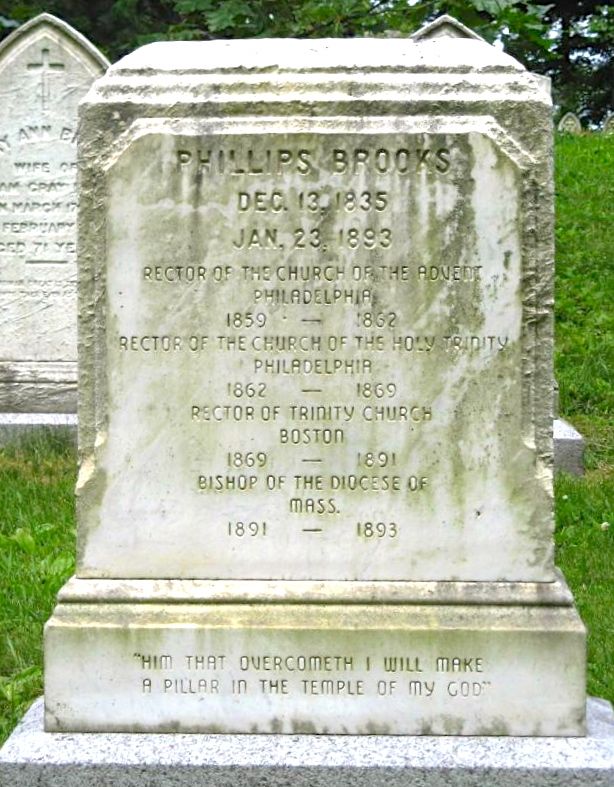
The Death of Phillips Brooks — January 23, 1893

P Brooks tombstoneRev. Phillips Brooks (1835–1893) died in Boston 120 years ago today. It is said that Christians throughout the world mourned his death, and his funeral was “like that of a king.” Brooks has been called by some “the greatest American preacher of the 19th Century.”

Yet sorrow soon turned to songs of triumph and praise of God for Phillips Brooks’ life. Over his tomb they would erect these words: “A preacher of righteousness and hope, majestic in stature, impetuous in utterance, rejoicing in the truth, unhampered by the bonds of church or state, he brought by his life and doctrine fresh faith to a people, fresh meanings to ancient creeds.” [Dan Graves in Christianity Today online article, June, 2007]

Brooks was the Episcopal Bishop of Massachusetts when he died, having also served important churches in Boston and Philadelphia. Most Americans know him as the author of the popular Christmas carol, O Little Town of Bethlehem — which he wrote a couple years after visiting Palestine in 1865. While there, Brooks journeyed from Jerusalem to Bethlehem on horseback, and there assisted with a midnight service on Christmas Eve. He would later write, “I remember standing in the old church in Bethlehem, close to the spot where Jesus was born, when the whole church was ringing hour after hour with splendid hymns of praise to God, how again and again it seemed as if I could hear voices I knew well, telling each other of the Wonderful Night of the Savior’s birth.”

On his preaching, the Encyclopedia Britannica says

In Lectures on Preaching (delivered at Yale University in 1877), Brooks offered his most influential assay of his profession, defining preaching as “the bringing of truth through personality,” by which he meant a kind of radiant optimism. His own eloquence was matched by his commanding, handsome figure, standing six feet four inches tall and weighing (in his prime) 300 pounds. His charismatic preaching became so renowned that he was invited in 1880 to preach at Westminster Abbey in London and at the Royal Chapel at Windsor before Queen Victoria. In 1890 he conducted an acclaimed series of services at Trinity Church, New York City. Several volumes of his sermons were published during his lifetime and posthumously. [online EB article]

At the Trinity Church in Boston (which Brooks helped design) there was no pulpit until 1888, but Brooks preferred to preach from a modest lectern near the rector’s stall, typically only wearing his black academic gown. And later on, during communion, he would preach not from the pulpit but from the chancel steps.

It is said that he despaired of Anglo-Catholic ritualism, and championed more congregational singing. During his childhood, the Brooks family spent Sunday evenings singing hymns. He would grow-up to know over two hundred hymns by memory, and often quoted them in his sermons.

Brooks was also known for his vocal defense of the Trinity as Unitarianism was then on the rise throughout New England.

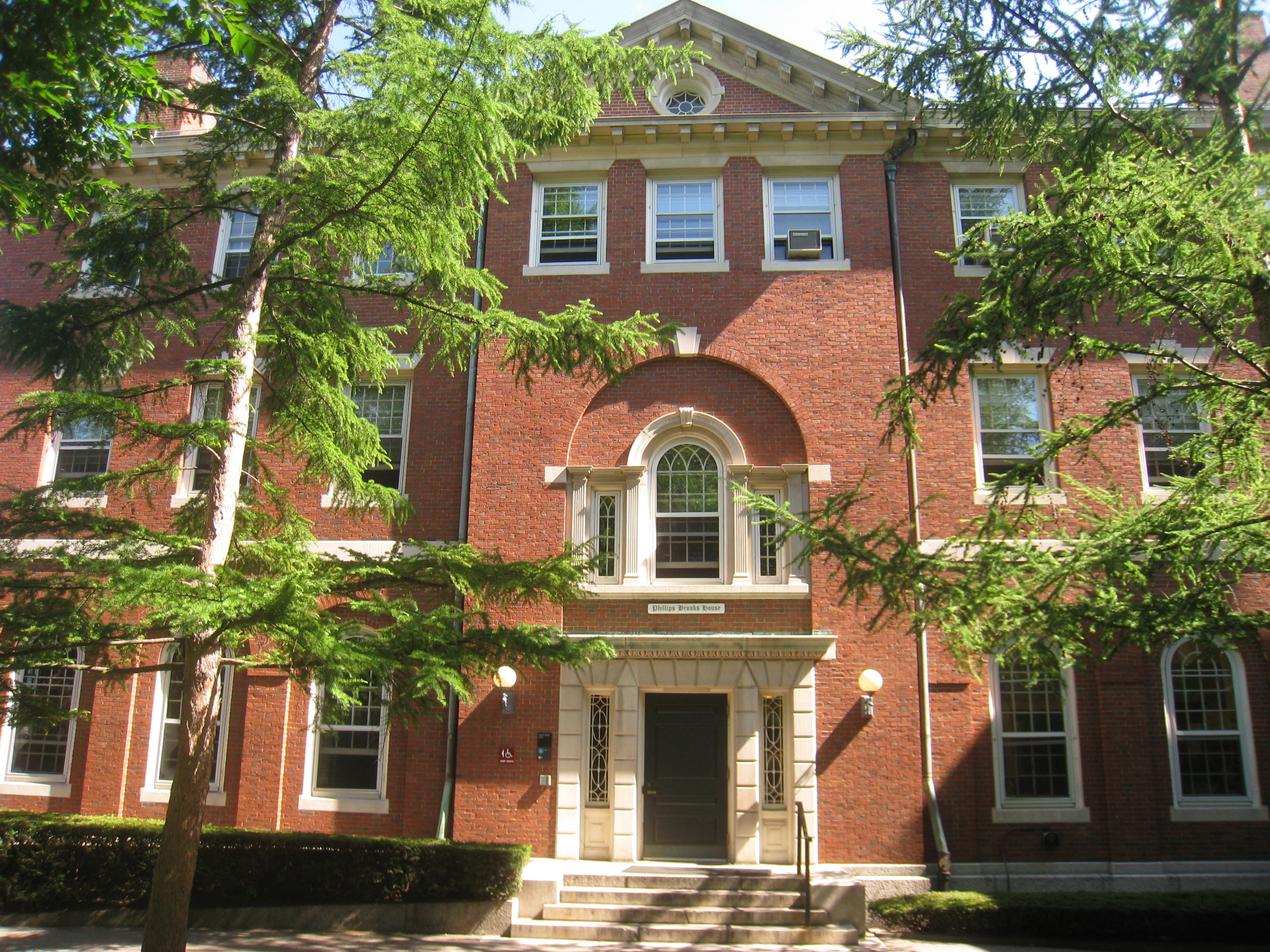
Phillips Brooks House at Harvard

Phillips Brooks House at Harvard

Brooks was a graduate of Harvard University and the Episcopal Seminary at Alexandria, Virginia. His close ties to Harvard led to the building of the “Phillips Brooks House” in the northwest corner of old Harvard yard (facing the small Holden Chapel). It was was dedicated on January 23, 1900, to serve “the ideal of piety, charity, and hospitality.” The Phillips Brooks House Association remains in operation to this day as a student-run consortium of over 80 volunteer organizations.

Phillips Brooks never married, or had children of his own. Dan Graves, in closing his Christianity Today article, observed that this famous preacher

…loved children and liked to romp on the floor and play with them. He often wrote delightful letters to his young friends. That explains why, when Brooks died on January 23, 1893, a five year old was upset because she had not seen her preacher friend for several days. Her mother told her Bishop Brooks had gone to heaven, and the child exclaimed, “Oh, Mama, how happy the angels will be.”

Yes, but happier yet would the man be, for he would now see Christ. He had written that the Christian’s goal should be “To know in one’s whole nature what it is to live by Christ; to be His, not our own; to be so occupied with gratitude for what He did for us and for what He continually is to us that His will and His glory shall be the sole desires of our life.”

Amen.