
Happy Birthday Library of Congress

On April 24, 1800, President John Adams signed the bill authorizing the creation of The Library of Congress in Washington D.C., which has become the world’s largest library. Bill Bennett, author of The American Patriot’s Almanac, says that it is “perhaps the greatest collection of stored knowledge in history.” Here’s the rest of his piece celebrating the LOC….
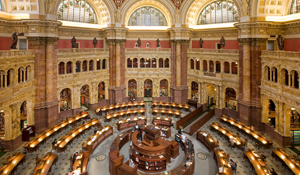
mainreadingroom_standard

It contains more than 140 million items, including maps, photographs, films, and recordings, on 650 miles of bookshelves. About 10,000 items are added every workday.

Congress established the library on April 24, 1800, when President John Adams signed a bill appropriating $5,000 for “the purchase of such books as may be necessary for the use of Congress” after it moved to Washington, the new capital city. The first books, ordered from London, arrived in 1801. The original collection consisted of 740 volumes and 3 maps.

The first collection was destroyed during the War of 1812 when the British burned the Capitol. Thomas Jefferson offered to replace it by selling Congress his personal library, one of the finest in the country. In 1815 Congress appropriated $23,950 to buy his 6,487 books. The Jefferson collection became the core of the Library of Congress.

The library serves as the research arm of Congress and the “storehouse of the national memory.” Unlike many other national libraries, its collection is not for scholars only. Anyone over high school age may use it. It also makes available, via the Internet, millions of files containing digitized versions of its collections. A library of the people, it has become a symbol of Americans’ faith in the power of learning.

Education as a way of life?

G. K. Chesterton once wrote, “Education is not a subject, and it does not deal in subjects. It is instead the transfer of a way of life.”

My mind has already turned to preparing for the coming school year — both in our home schooling, and in our church ministry. The above quote certain pushes one’s thoughts and plans to a whole new level. But then, again, shouldn’t Christians already be aware of this, that education is a whole life activity — engaging all areas, throughout one’s whole life? I think so. This is why we are called “disciples” (learner/followers) of Jesus.

And not only that, but we are disciples who have been commissioned to make more disciples! The passage at the end of the Gospel of Matthew now only gives the church this order, but in so doing reveals the essence of discipleship:

16 Now the eleven disciples went to Galilee, to the mountain to which Jesus had directed them. 17 And when they saw him they worshiped him, but some doubted. 18 And Jesus came and said to them, “All authority in heaven and on earth has been given to me. 19 Go therefore and make disciples of all nations, baptizing them in the name of the Father and of the Son and of the Holy Spirit, 20 teaching them to observe all that I have commanded you. And behold, I am with you always, to the end of the age.”

It would seem that discipleship (the education or ‘making’ of a Christian) aims to cover ALL that Jesus taught, and to make sure it is not only LEARNED but OBSERVED (practiced/obeyed). So, tweaking the Chesterton quote a litte, we could say this: “Christian discipleship is not a subject, and it does not deal in subjects. It is instead the transfer of a way of life.”

~ pdb