

I hope you know of one of the greatest preachers in the history of the 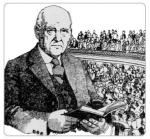 English language, Dr Martyn Lloyd-Jones (more info here). Today marks the 30th anniversary of his death, his passage to glory, on March 1st, 1981. Through his many published sermons and subsequent audio recordings, the Doctor still ministers the Word of God to millions.
— pdb
“I regarded Dr Martyn Lloyd-Jones with admiration and affection during the years that we were both preaching in London, so I am delighted that his unique ministry is to be more widely available in the United States.”
– John Stott was the former pastor of All Souls’ Church, Lancaster Gate, London
“There is very little great preaching today. Most of us are too bent on being good communicators to be good preachers. We are too clever and too funny. What a gift, therefore, to be confronted and comforted again and again with the preaching of Martyn Lloyd-Jones. I think preachers need to hear this kind of preaching as a partial antidote to the relentless trivializing of preaching in our day.”
– John Piper is the Pastor for Preaching and Vision, Bethlehem Baptist Church, Minneapolis, Minnesota
“Martyn Lloyd-Jones was not the only faithful preacher of the gospel in the mid-twentieth-century Western world, but the sense of spiritual reality–of God, of sin, of grace, of Christ, of the individual in the hands of God-that he conveyed by the way he said things in his expositions was unique to himself, and very, very powerful. And much of this still comes through as we encounter his recorded and transcribed sermons. So the work of the MLJ Trust, which maintains the ministry of “The Doctor” via modern electronics, is something for which to be profoundly thankful”
– Dr. James I. Packer is the Board of Governors’ Professor of Theology at Regent College in Vancouver, British Columbia
“D. Martyn Lloyd-Jones was without question the finest biblical expositor of the 20th century. In fact, when the final chapter of church history is written, I believe the Doctor will stand as one of the greatest preachers of all time. His style of biblical exposition was meticulously thorough and yet full of energy. “Logic on fire,” was his famous description of preaching, and he had an amazing gift for blending passion and precision in copious measures. He influenced countless preachers (myself included), and he stood steadfastly against the superficial, entertainment-oriented approach to preaching that seemed to dominate the evangelical world then as it does now. Lloyd-Jones still desperately needs to be heard today, and I am profoundly grateful for the work the MLJ Trust is doing to keep his voice alive.”
– Dr. John F. MacArthur, Jr. is the Pastor-Teacher of Grace Community Church in Sun Valley, California
“Martyn Lloyd-Jones was one of the titanic figures of twentieth-century Christianity. What now sets him apart is the fact that his writings, sermons, and other messages are even more influential now, more than two decades after his death, than when he engaged such a massive ministry at Westminster Chapel and beyond. Why? I think the answer is simple – his profound commitment to biblical exposition and the great skill with which he preached and taught the Word of God. In an age when so many preachers seem so unsure of what preaching is, in Martyn Lloyd-Jones we find a minister that leaves no doubt. I am so very thankful for the ministry of the Martyn Lloyd-Jones Trust.”
– Dr. R. Albert Mohler, Jr. is the President of The Southern Baptist Theological Seminary
“Dr. Martyn Lloyd-Jones was one of the greatest preachers of the twentieth century in the English speaking world. In some ways he was a maverick: he had no concern to observe homiletical rules and political correctness. He did expound Scripture powerfully—chapter after chapter, enabling his hearers to feel the massive weight of every topic with which he was concerned. Add to this a rare unction—an old Puritan word that needs to be restored to our vocabulary—and you begin to understand why his influence reached as far as it did. Every time I listened to him I came away richly conscious that I had met with the living God. Here are sermons which, while picking away at individual texts, maintain a clear connection with the gospel that runs right through the whole of the Bible. It is a pleasure to commend these sermons to a new generation of hearers.”
– Dr. Donald Carson is research professor of the New Testament at Trinity Evangelical Divinity School, which is based in Deerfield, Illinois

 The Breadline